

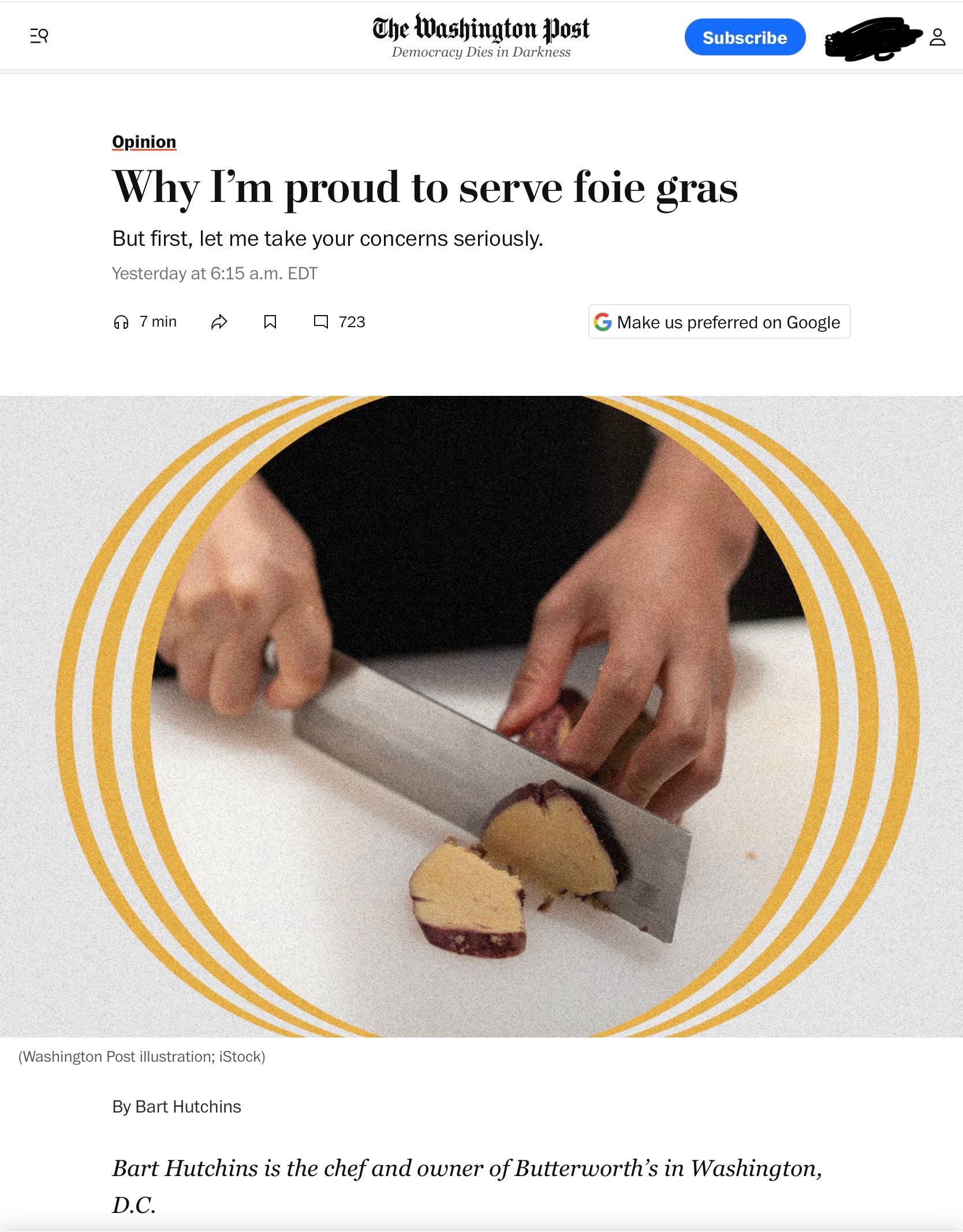
I have just read a passionate defence of foie gras written by Bart Hutchins in The Washington Post (thanks Mary F for spotting the article). Bart is the chef and owner of Butterworth’s in Washington, D.C., and what struck me most was not the argument itself, but the way it was presented. It felt as if it had been written by a 60 years old French chef but it wasn’t…. The article is wrapped in nostalgia, memory, admiration for great chefs, tales of culinary perfection, personal vulnerability and longing for a disappearing world. We were invited to follow the journey of Jean-Louis Palladin smuggling foie gras into America, to sympathise with a young chef devastated by a failed foie gras soup ( mmm, I know…), and to admire the dedication of chefs willing to suffer in pursuit of excellence. It was beautifully written, and that is precisely why it deserves scrutiny.
Because the article is not really about foie gras at all. It is about making us feel something for the people who produce it, cook it and serve it. It asks us to admire their passion, their craftsmanship and their commitment to tradition. It carefully guides our emotions toward the chef, the farmer and the culinary heritage they represent. What it does not do is extend the same curiosity, empathy or imagination to the one individual whose interests matter most in this story: the duck.
This is often how the defence of animal exploitation works in the modern age. We no longer speak openly of domination or entitlement. Instead, we romanticise, we tell stories about beautiful farms, devoted producers and generations of tradition. We speak about care, respect and excellence. The victim gradually disappears behind the scenery. By the end of the article, the reader has been encouraged to feel deeply for the chef who almost abandoned his profession after overcooking a piece of foie gras, yet has barely been invited to consider the experience of the animal whose life made that dish possible.
The author repeatedly reassures us that force-feeding is not as bad as activists claim because ducks naturally gorge before migration, because their anatomy differs from ours, because they do not possess the same gag reflex as humans and because the feeding process lasts only a few seconds (we know it is not true but never mind). But this entire line of reasoning misses the point. The ethical question is not whether we can make force-feeding appear less shocking than the public imagines. The ethical question is why we are manipulating and exploiting an animal in the first place. The fact that a duck possesses a biological capacity that can be exploited commercially does not provide a moral justification for doing so. An animal’s adaptation to nature is not an invitation for humans to turn that adaptation into a luxury product.
What I find particularly revealing is the author’s desire to distinguish foie gras from other forms of animal agriculture. He condemns factory farming, crowded pig sheds and industrial chicken production, and presents his own foie gras supplier as an example of care and responsibility. This is a familiar argument and one that drivesd me absolutely up the wall. We are encouraged to believe that there is a meaningful moral distinction between the animals we treat badly and the animals we treat well before killing them. Yet the fundamental question remains untouched. However comfortable the barn, however attentive the farmer and however gentle the handling, the animal still loses the only thing that truly belongs to them: their life.
The method changes, but the outcome does not.
What makes the article feel strangely out of touch with our time is that it never seriously engages with what science has increasingly revealed about animals themselves. We now know far more than previous generations about animal consciousness, cognition, emotion and social behaviour. Ducks are not objects. They are not ingredients waiting to be transformed by pseudo culinary genius. They are conscious individuals with their own experience of the world, their own preferences and, most importantly, their own interest in continuing to live. Once that fact is fully acknowledged, the conversation changes completely. The debate is no longer about gastronomy, tradition or craftsmanship. It becomes a question of whether our pleasure can justify taking the life of another conscious being.
There is another aspect of Hutchins’s article that I find difficult to ignore. Butterworth’s has become known in Washington as a gathering place for many figures associated with the MAGA movement. I mention this not because every customer shares the same beliefs, nor because a chef should be judged solely by the people who dine in his restaurant. Rather, I mention it because the article itself appears to embody something larger than a defence of foie gras.
Running through the piece is a longing for an older order of things. We are invited to admire traditions because they are traditions, to celebrate customs because they have existed for a long time, and to trust inherited practices because previous generations trusted them. The emotional force of the article comes not from its ethical arguments but from its nostalgia. It asks us to look backwards and find comfort there.
Yet moral progress has rarely emerged from nostalgia. Throughout history, societies have repeatedly discovered that tradition alone is not a moral defence. The fact that something has been practised for generations does not tell us whether it should continue. Many of the customs we now reject were once protected by appeals to heritage, culture and the wisdom of the past.
This is why the debate around foie gras feels larger than foie gras itself. It reflects a deeper tension between two visions of the world. One looks backwards, seeking legitimacy in tradition, hierarchy and inherited habits. The other asks whether our expanding knowledge should lead us to expand our compassion as well.
One places human desire at the centre of the moral universe. The other begins to recognise that the interests of other conscious beings matter too.
What ultimately troubled me about Hutchins’s article was not its defence of foie gras but its attempt to persuade through sentimentality. It plays upon something deeply human: our affection for stories, our admiration for mastery and our longing for a world that feels authentic and meaningful. Yet nostalgia has never been a reliable guide to morality. The fact that something has been done beautifully, passionately or for a long time does not answer the question of whether it should continue to be done at all.
For me, the article reveals the weakness of the modern defence of foie gras. It relies so heavily on the romance surrounding the people involved because the reality itself has become increasingly difficult to defend. Once the curtain of nostalgia is pulled aside, once the stories of chefs and traditions are placed to one side, we are left facing a remarkably simple question.
If we no longer need to force-feed ducks, kill them and eat their enlarged livers in order to live healthy and fulfilling lives, why should we continue doing so?
No amount of culinary poetry can ultimately avoid that question.
You can read the article here, behind the paywall if you register an email address: https://wapo.st/49Uvv8u
Was this ever necessary, Mr. Gauthier?
I think foie gras is a more extreme example of the sadism inherent to human supremacism. I mean, how do people come up with this? Maybe you can offer some insight.
To illustrate my point, this Troy Vettese article talks about what's done to Ortolan buntings:
"Poachers use glue and nets to catch the tiny creatures as they rest in trees after an exhausting migratory flight over the Mediterranean. Sold to restaurants, the captives are blinded or immured, as darkness triggers instinctual gorging. After adding a few grams to their minute frames, they are taken, still alive, and plunged in brandy to drown, then marinate, before being plucked and roasted. Connoisseurs speak rapturously of juices bursting from ruptured organs, of how small bones lacerate the inside of one’s mouth heightening one’s sense of taste."
https://www.currentaffairs.org/news/the-left-has-failed-animals
I wrote the poem below on a similar theme. Man seems to ignore any suffering he chooses in pursuit of so called gastronomy!!!
Ambelopoulia (birds of the vineyards) is a controversial dish of grilled, fried, pickled or boiled migratory songbirds which is a traditional dish enjoyed by native Cypriots. Whilst trapping ambelopoulia is illegal in Cyprus, there is a lucrative black-market trade in songbirds.
Ambelopoulia
In the space of silence split from the sky
you trudge home. The dawn chorus in your buckets.
Mist nets bridge the natural gap
between trees.
Three hundred at a time.
Three hundred in a net
worth more than one in a bush.
Tiny talons fused to lime sticks.
You nip the necks: taste life
escaping, warm, metallic,
your lips skimming feather and fragile bone.
Lips that will later kiss
your children, suck on your wife’s breast.
An invisible tomb trembling
from tree to tree,
fluttering feather
frantic to escape.
Tiny hearts beating fast
until you crush them careless
of clutches cooling in a naked nest.
Brood hen despatched, from the skies
to feed your anachronistic tradition:
brave hunter that sings a suffering songbird to sleep with boiling water and glue.